We wrote the framework. Then I made it run.

Chris gave each DFC brand one simple thing to stand for. We wrote down how it has to show up on a storefront: five areas, and a method that holds for any brand. Then I built the tool that runs it, one area first.

brands run through it
4
roadmaps approved
2
Role
Led it end to endco-wrote the framework, planned the tool, designed and built it
Title
Lead UI/UX Designer, Digital Fuel Capital
With
Chrisbrand strategy partner, co-authorCarsonPresident, sponsor
Scope
Homepage · PDP · PLP
When
Mar – Sep 2026

Brand UVP Audit

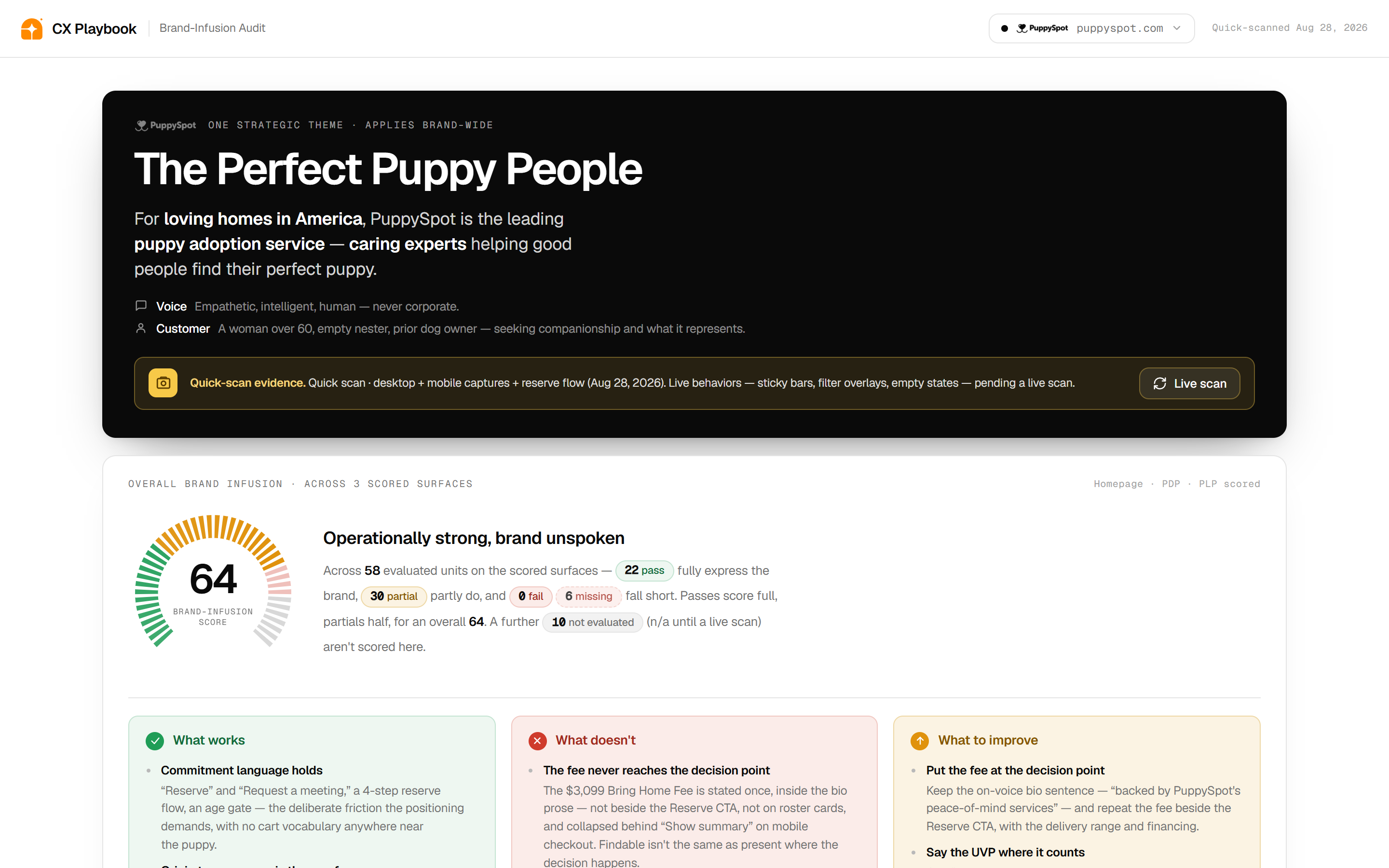
The tool's northstar screen for PuppySpot: The Perfect Puppy People, the value proposition, the voice, a brand-infusion score of 64, and what works, what doesn't and what to improve
01Collect · Resolve
The brand, as data: eleven pills, each with a source
02Scan · Map · Score
Every page, scored on one of five areas
03Playbook
A ranked list of fixes

Potion×11

The brand's strategy as eleven pills, each from its own documents.

Stage 03 · Brand ingestion

Lantern

Every page of the storefront, scanned on desktop and mobile.

Stage 04 · The tool

Gem

One area, done properly: UVP Clarity.

Stage 05 · Too wide, then narrow

Map

From the examples: why what works works, and the move that fixes what doesn't.

Stage 02 · The examples
Scroll to continue

Stage 01The problem

Stage 01 · The problem

The strategy lived in a document. The site lived in five teams.

Chris gave each brand one simple thing to stand for. Five teams built the storefront. None of them owned how the brand showed up.

The Brand One simple thing, in a document Growth paid medialanding pages sells the deal Product homepagenavigation sells the site Merchandising product pageslistings sells the SKU Operations cart · shippingsupport sells the policy Retention emailloyalty sells the discount No bridges: five teams, five versions of the brand
Covie

A DFC storefront is five workstreams: growth, product, merchandising, operations, retention. Each ships every week, in its own voice, and the customer is the only one who walks the whole row.

Checking whether the brand survived all five was a weeks-long audit. So it happened once, or not at all. The March 2026 deck put it this way: “You can't improve what you can't see. A manual CX audit takes weeks and costs tens of thousands, so it either doesn't happen, or happens once and goes stale.”

So I asked what it would take to run the strategy instead of reading it.On to the next stage
Stage 02 · The examples

Work backward from the examples to the why.

Carson asked for a library of best-in-class UVP expression. A library shows what's good, not why. The why is the part that travels.

MacroThe order of a page

  1. Mission stripBrand strip
  2. Hero: Manage Your MicroclimateHero
  3. Product carouselProduct carousel
  4. Provisions story · Shop UsedBrand story
  5. Activity gridCategory grid
  6. Latest storiesEditorial
  7. Values bandBenefit bar
  8. Social proof

The rulePut the element that proves your differentiator at the moment the visitor's matching doubt is live.

Why it worksMission brackets the store, a strip on top and a values band below, and goods alternate with story so the catalog reads as activism. The order is the argument.

What diesIn the footer, the message lands after the decision. A disclaimer, not an intervention.

  1. 1 Hero hookDeath Wish CoffeeOne falsifiable claim asserts the one attribute it owns, intensity, instantly.
  2. 2 Social proofBombasThe proof echoes the brand's one thing, a count of what it gives, not generic stars.
  3. 3 Category labelsLiquid DeathIrreverent lexicon in a utility element carries the anti-corporate voice.
  4. 4 Benefit barAllbirdsDifferentiated props, natural materials in place of petroleum-based synthetics, not commodity reassurances.
Covie

Every example was checked against the live site before it went on a slide. Everlane was dropped after the Shein acquisition. Patagonia was re-read twice.

The test that made each why explicit: move the block that proves the brand's differentiator, and see what dies.

The library had two levels. The order of a whole page, then one block done right: a hero, a set of labels, a spec, in the brand's own words.

So each why became a guideline, and each guideline names the brand signals it needs.On to the next stage

Stage 03 · Brand ingestion

Turn the brand into data.

Every document goes into an inventory. Eleven pills come out, each with a source and a status. An open pill blocks every question that needs it.

Documents

Pills

position

expression

proof

audience

Questions the page is asked

PDP

PLP

documented derived suggested open Point at a card to trace it
Covie

Where documents disagree, the newest wins and the conflict stays on the pill. A suggested name stays a suggestion, never a fact.

This is Ledge's real sheet. Hover a pill to see what fed it and what it answers.

Now the page. A scan reads it the way a visitor would.On to the next stage

Stage 04 · The tool

One audit, two readers.

Carson wants to know how well the storefront carries the brand and what to decide. Brooke wants five things to do, with links. The same run answers both.

  1. The toolOne page per surface, top to bottom

    1. 1Northstar & scoreThe brand as the tool reads it, and how much of it the page carries.
    2. 2The page as capturedDesktop and mobile, beside the visitor's questions, in order.
    3. 3What to fixEach move typed, ranked and pinned to the block it changes.
    4. 4StructureEvery block in its current and its suggested order, each with a verdict.
  2. 1 · Northstar & scoreCarson reads

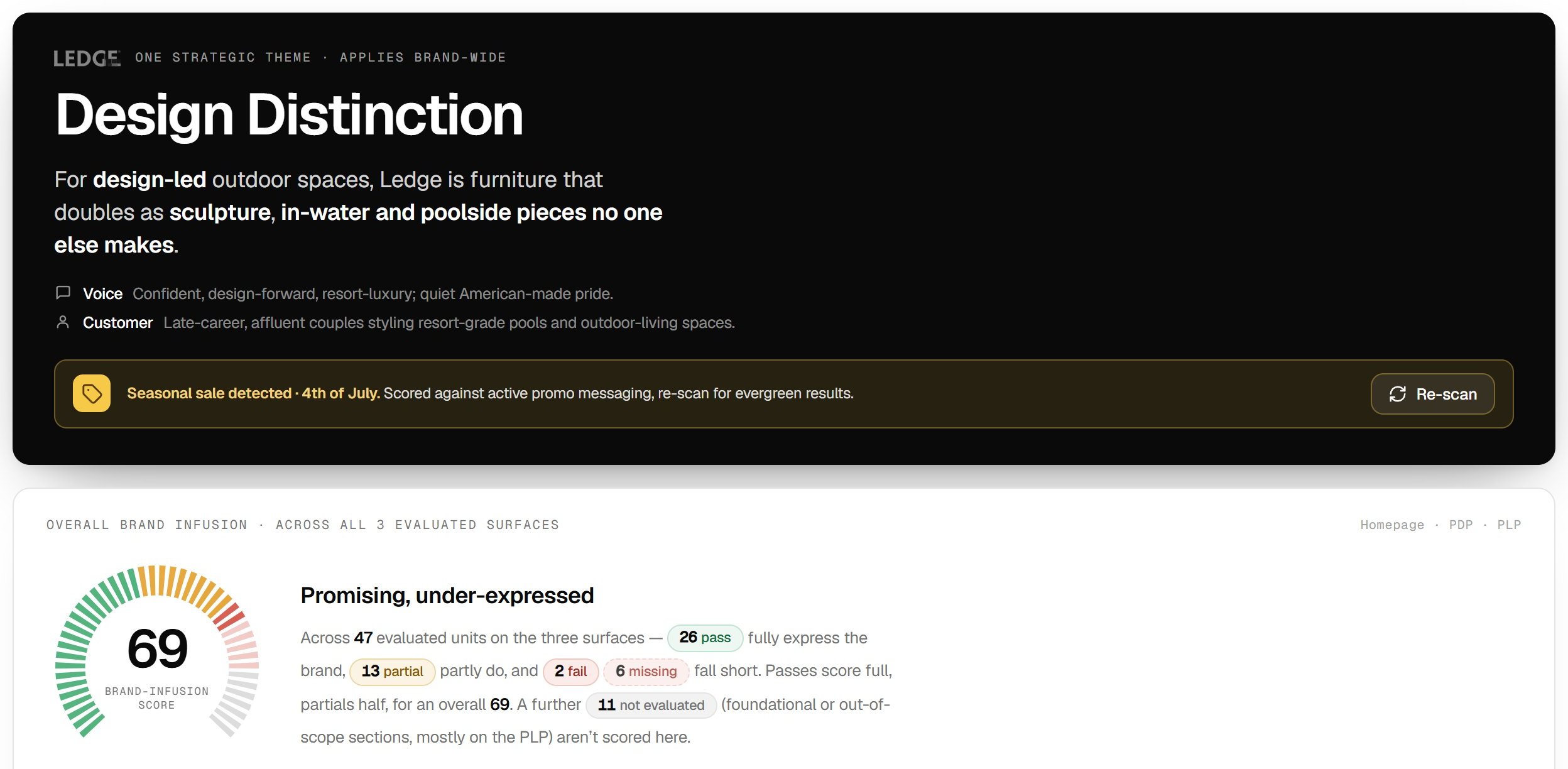
    The northstar: Ledge's one simple thing, Design Distinction, the value proposition, the voice and the customer, the 4th-of-July sale flagged, then the brand-infusion score, 69: promising, under-expressed
  3. 2 · The page as captured

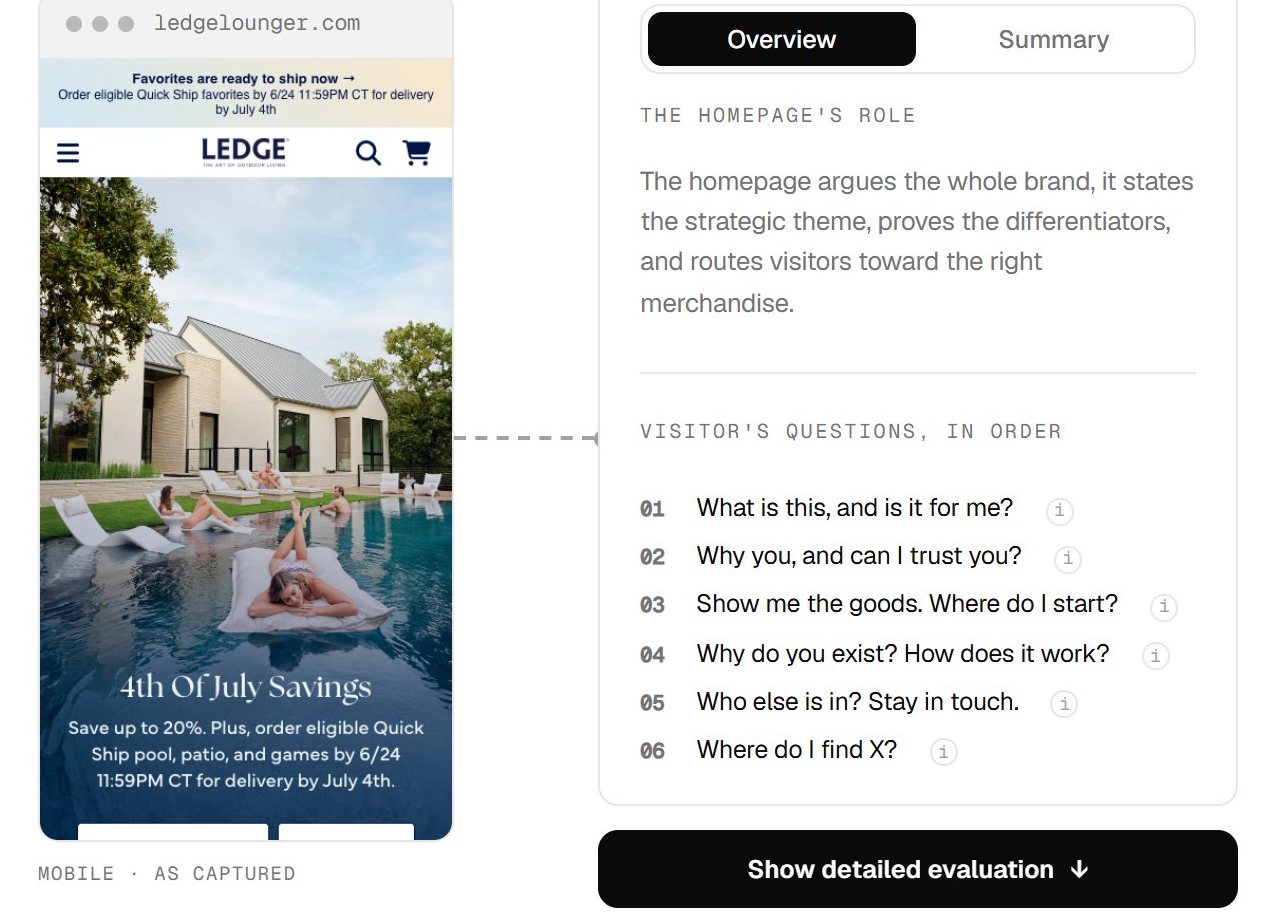
    Ledge's homepage as captured on mobile, a 4th-of-July savings hero, beside the page's role and the visitor's questions in order
  4. 3 · What to fixBrooke reads

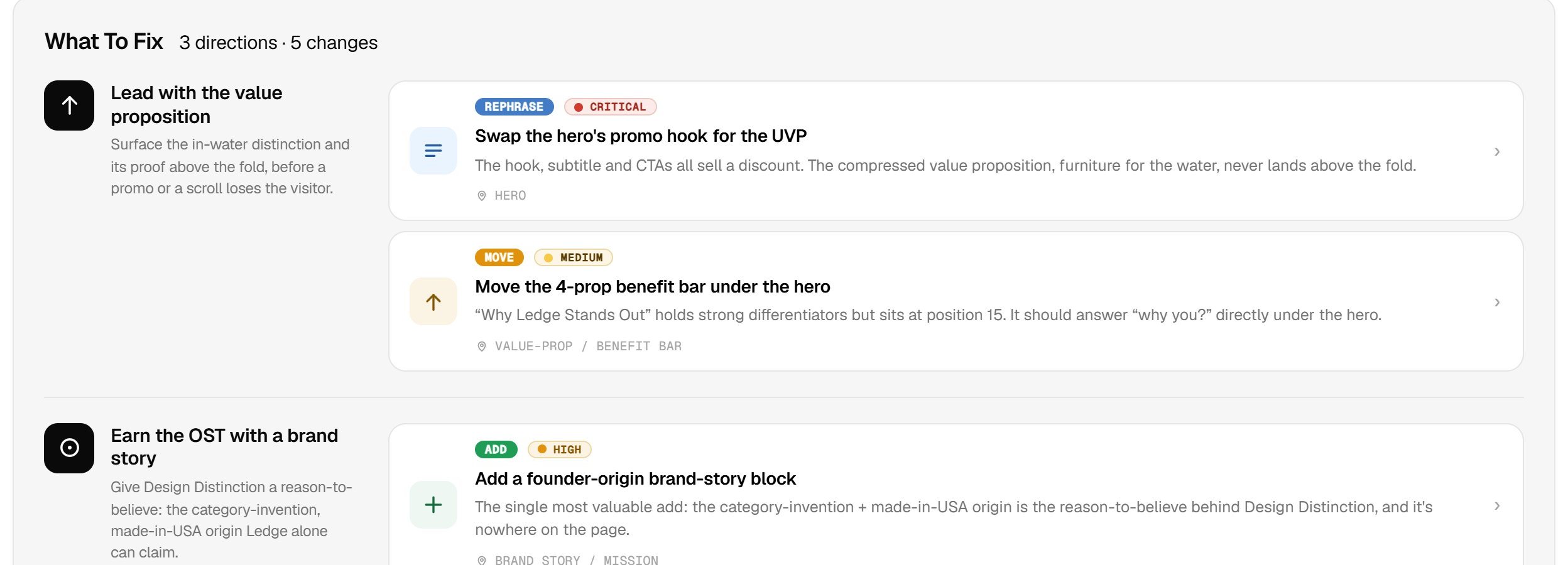
    What to fix, three directions and five changes: lead with the value proposition, swap the hero's promo hook for the UVP (rephrase, critical) and move the benefit bar under the hero (move, medium); earn the OST with a founder-origin brand story
  5. 3 · Micro · the words, rewrittenBrooke reads

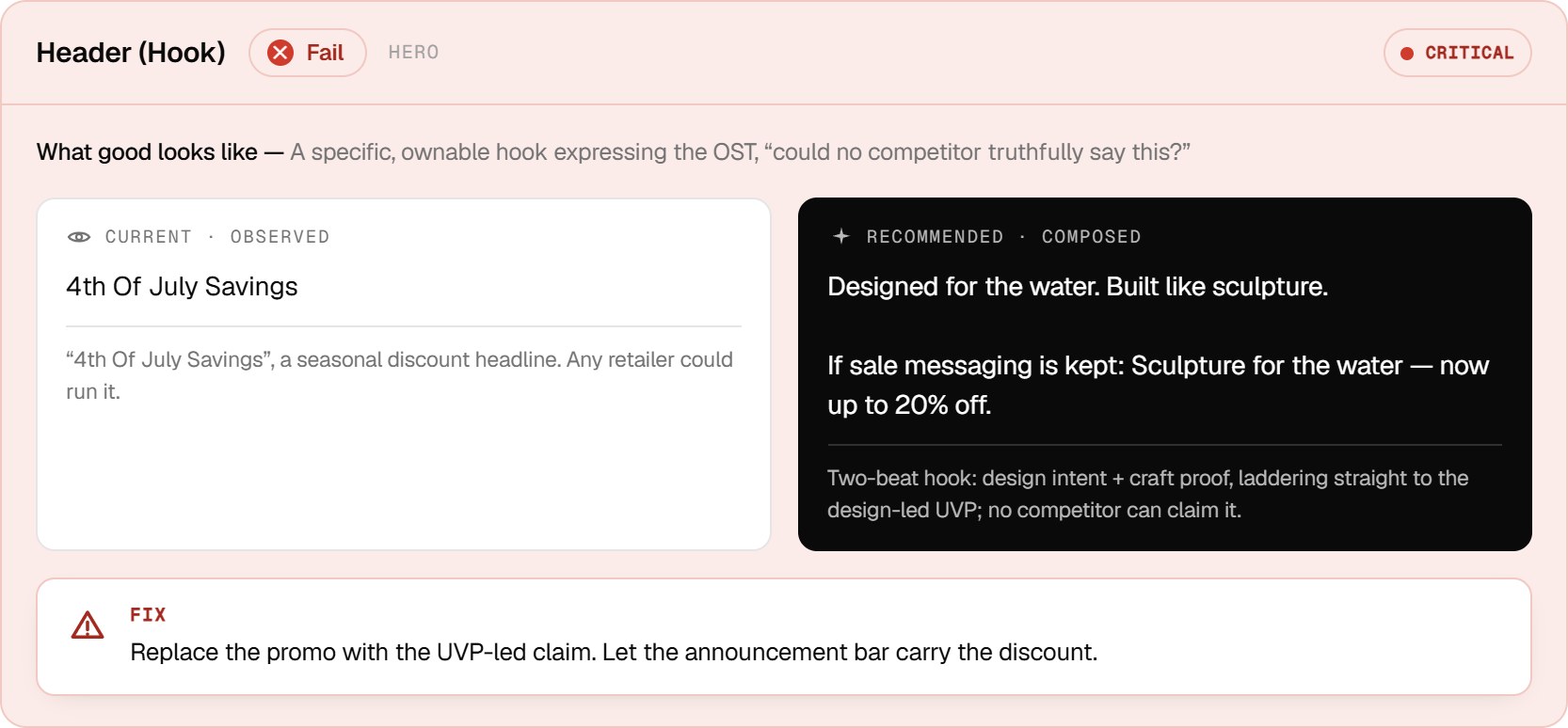
    Opened fromWhat to fix: Swap the hero's promo hook for the UVP

    The hero's hook: currently 4th Of July Savings, a discount any retailer could run. Recommended: Designed for the water. Built like sculpture.

    Homepage · Hero · the hook

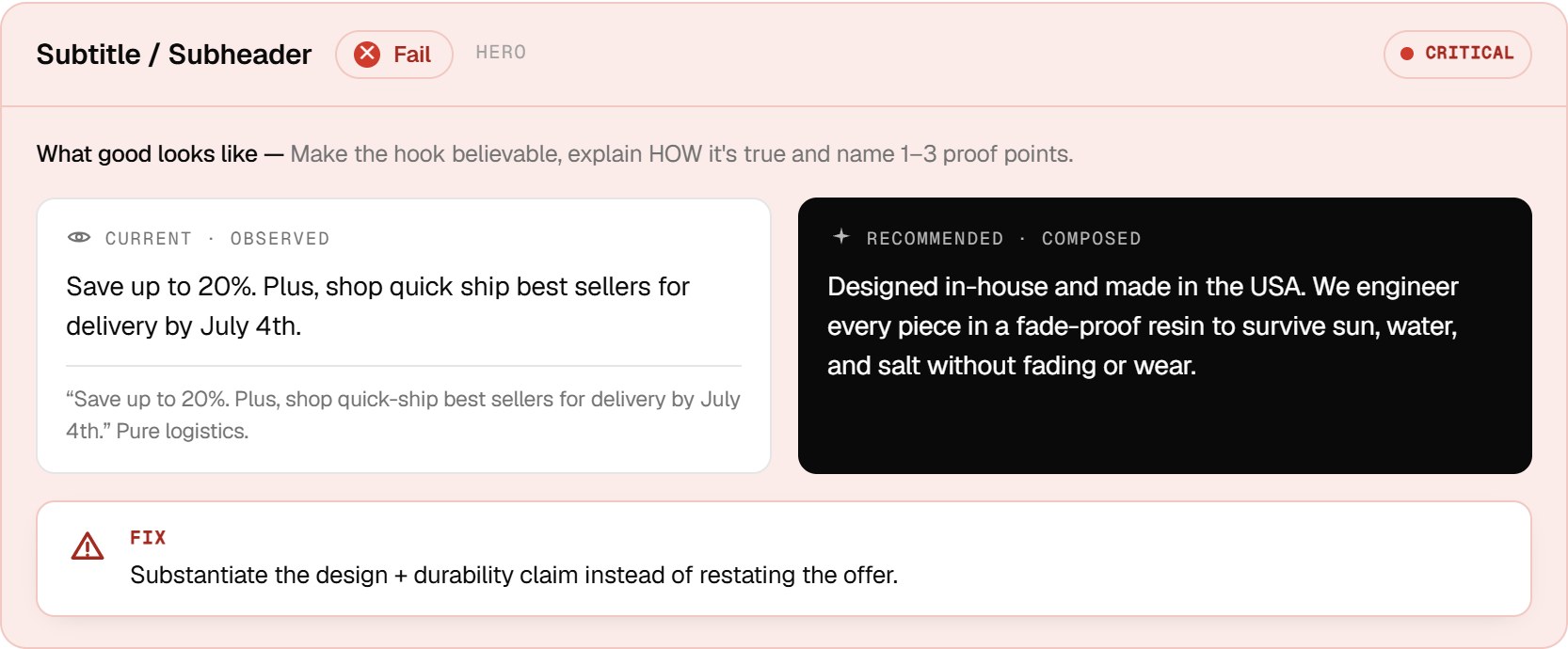
    The hero's subtitle: currently Save up to 20%. Recommended: Designed in-house and made in the USA, engineered in a fade-proof resin to survive sun, water and salt.

    Homepage · Hero · the subtitle

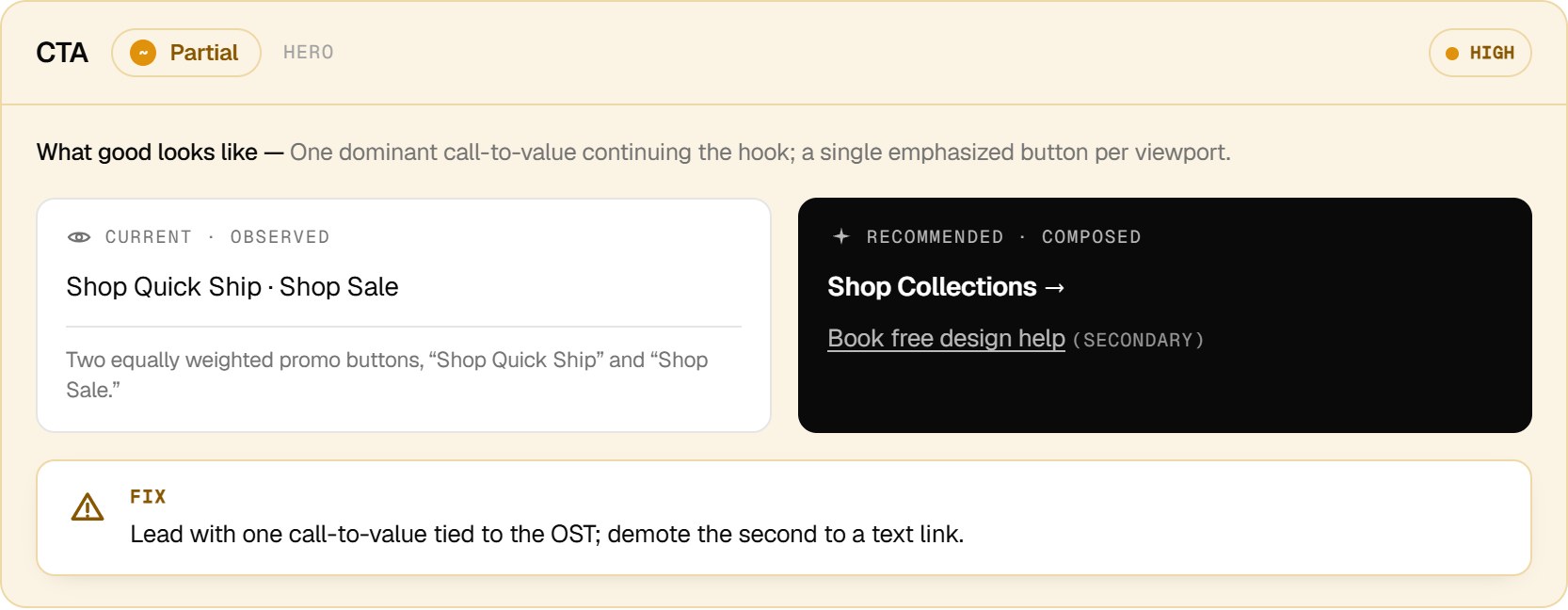
    The hero's call to action: currently two promo buttons, Shop Quick Ship and Shop Sale. Recommended: Shop Collections, with Book free design help as a text link.

    Homepage · Hero · the call to action

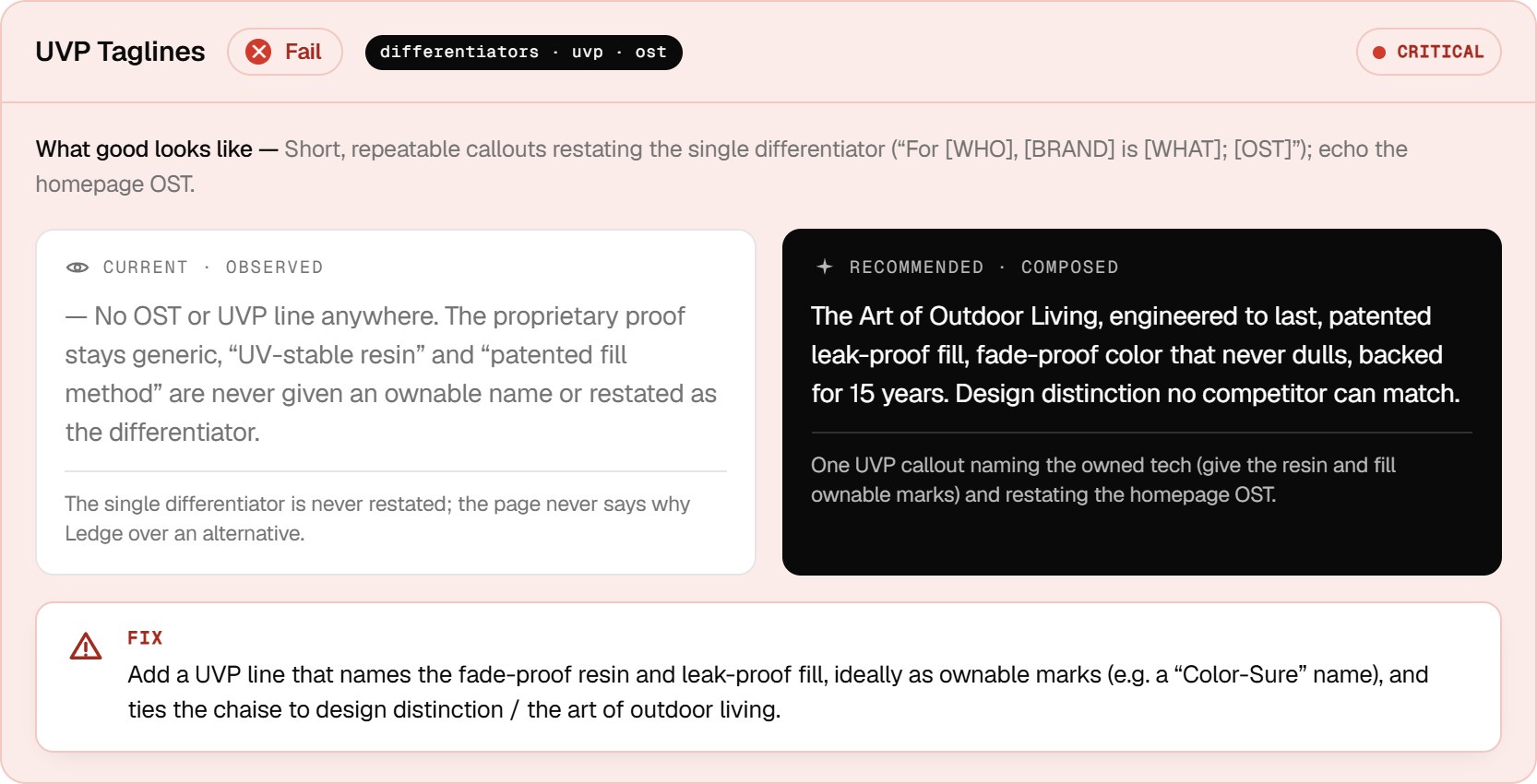
    The PDP's UVP taglines, drawn from three pills, differentiators, UVP and OST: currently no UVP line anywhere. Recommended: The Art of Outdoor Living, engineered to last, backed for 15 years.

    PDP · Product description · the taglines · Composed from three pills

  6. 4 · Structure

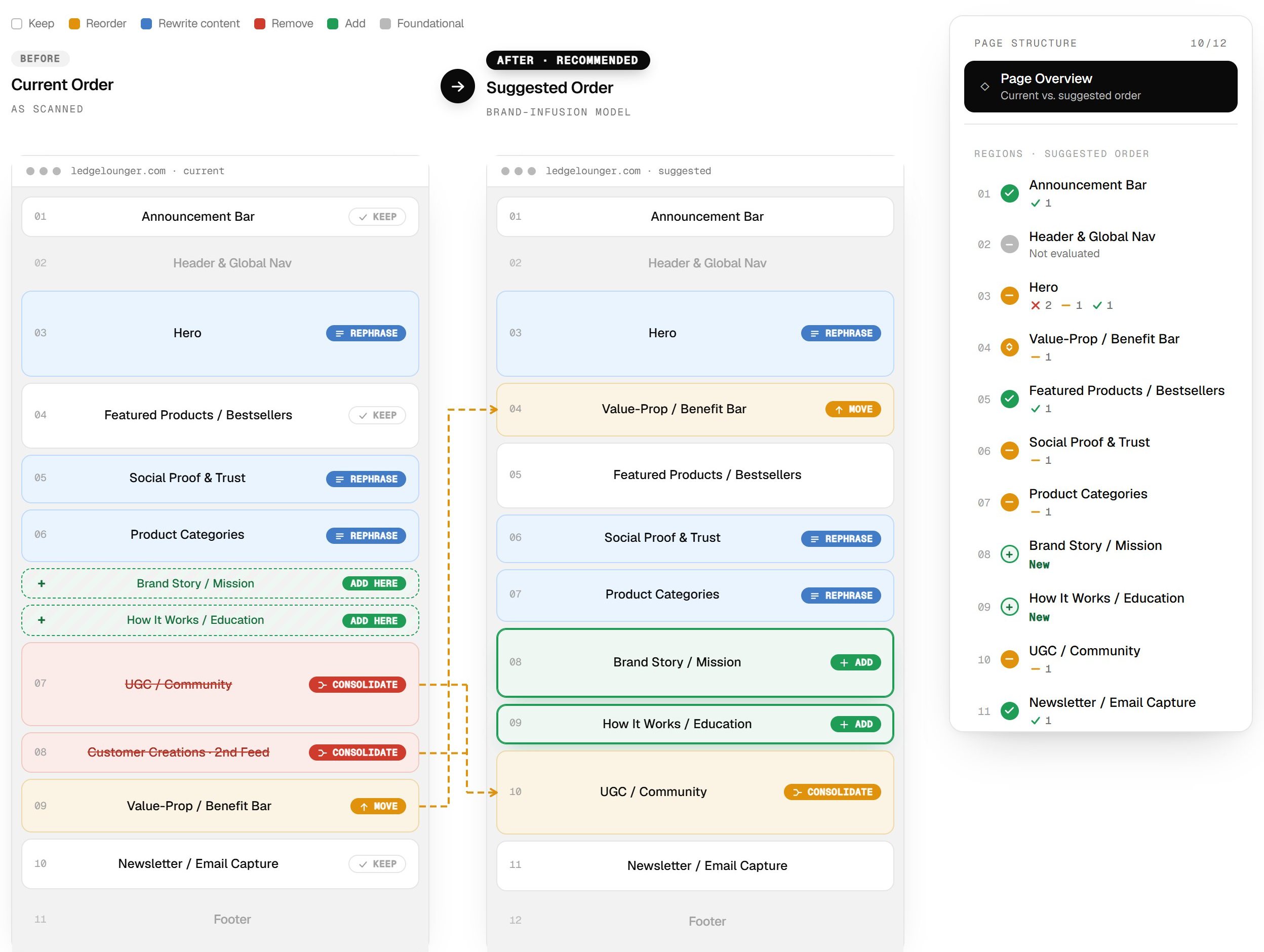
    The structure: every block of Ledge's homepage in its current order beside the suggested order, rephrase, move, add and consolidate marked, and the page structure beside them
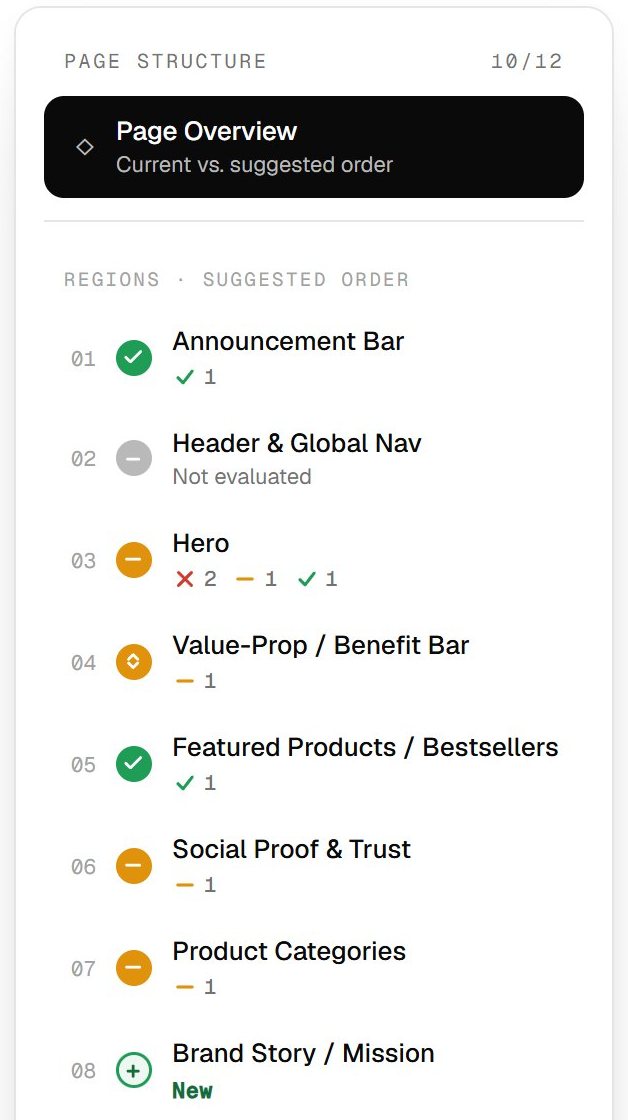
    The page structure's verdicts: announcement bar present, header and global nav not evaluated, the hero failing, the benefit bar to move, brand story and how it works new
  7. 4 · Macro · the blocks, reordered

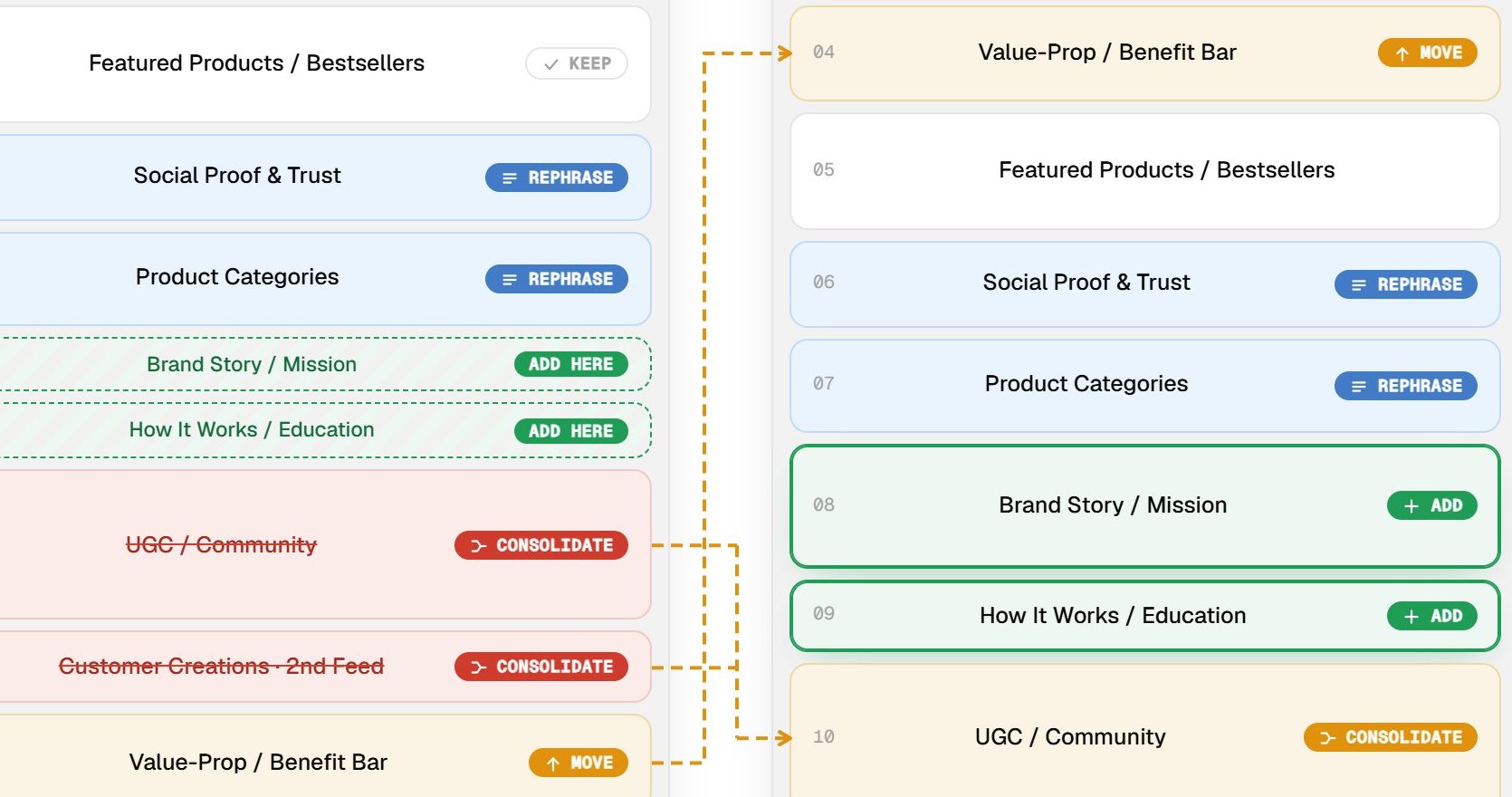
    Up close: the benefit bar tagged MOVE in ninth place, a dashed arrow up to fourth place under the hero; around it blocks tagged rephrase, add here and consolidate

    Macro changeMove a blockThe benefit bar, 9th to 4th, under the hero. Every block is tagged with its change.

Covie

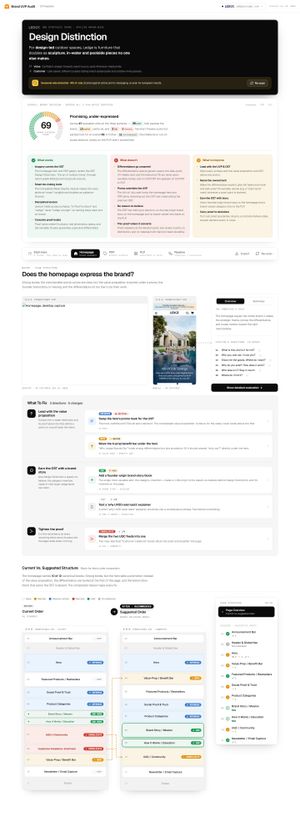
This is the tool, one page per surface, read top to bottom: the brand's northstar and its score, the page as captured, what to fix, and the structure.

The northstar: the one simple thing, the value proposition, the voice, the score, and where it comes from: what works, what doesn't, what to resolve.

Ledge was scanned during the 4th-of-July sale and the verdicts say so. Coyuchi's homepage is served by a personalization layer, so its copy is judged from captures and marked.

What to fix: each move typed, ranked and pinned to the block it changes. Start here gathers them across surfaces into one list, sized in hours, days or weeks, and tagged safe to ship, test first or brand bet.

Micro: the words inside a block, rewritten in the brand's own terms. Ledge's hero gets three. On the PDP, a rewrite shows the pills it was composed from.

A section is missing only when nothing maps to it. Not evaluated is a verdict.

Macro: the order of the page. Every block carries its change, and an arrow runs from where a block is to where it goes.

That's the tool as it is. It isn't how it started.On to the next stage

Stage 05 · Too wide, then narrow

I started too wide. Then I picked one.

My first build, CX Playbook, audited the whole journey, 146 guidelines deep, and was never accurate enough to ship. One area, done properly, was.

01

UVP ClarityDoes the page say what this brand is, for whom, and why?

Refining now

02

Friction ReductionDoes anything stand between wanting it and having it?

Later

03

Trust & ProofIs the promise substantiated where the doubt is live?

Later

04

Emotional ConnectionDoes the customer recognize themselves?

Later

05

MomentumIs there a reason to come back and buy again?

Later

Covie

Five areas, three layers of evidence, a browser that segmented pages on its own, three vision models per guideline. Every fix was real. None of them made the whole trustworthy.

The value proposition is the one area the other four depend on. Get it right on the three pages where it's decided, and the rest has something to stand on.

One brand end to end. Then the next.On to the next stage

Stage 06 · Four brands

Run one brand end to end before asking for the next.

Ledge Lounger went through all six stages and became the demo. Then PuppySpot, Coyuchi and Disturbia.

  1. 01The brand 01 · Collect · ResolveThe brand's documents and its live site, read into eleven pills, each with a source.
  2. 02The score 02 · Scan · Map · ScoreEvery page captured, desktop and mobile; each region mapped onto the canon and scored against the pills.
  3. 03The fixes 03 · PlaybookA ranked list of fixes, each sized, tagged and linked to its diagnosis.
  4. Roadmap RoadmapThe fixes, built into the brand's roadmap and approved.

RoadmapLedge Lounger

Built and approved.

Ledge's playbook became its roadmap, and the roadmap was approved. [Covie: what went on it, who approved it, and when.]

RoadmapCoyuchi

Built and approved.

Coyuchi's audit fed a roadmap that was built and approved. [Covie: what went on it, who approved it, and when.]

Covie

PuppySpot is a service brand, which forced a fourth vertical into the canon. Coyuchi was a live scan, with 17 insight pills from call transcripts. Disturbia is ingested, waiting for a scan.

The engine never bends to a brand. A new brand adds data files only.

So what changed?On to the next stage

Stage 07 · What changed

What changed at DFC.

The audit became a step in roadmap planning, and every fix now carries the brand's own words. Five teams, one standard.

  • Examples are not a framework. The why is what made it reusable.

  • Score the specific, not the generic. A Ledge ticket could not be a Disturbia ticket.

  • Calibration is the hard part. Reading a brand's own documents honestly took more build than the vision did.

  • Ship tickets, not scores. A score is a diagnosis. A ranked list is a decision.

Covie

Before, each team argued from its own read of the brand. Now a fix cites the pill it answers to, and the team that owns the page owns the fix.

And what I'd do differently.On to the next stage

Stage 08 · Differently

I'd do the hand-made v1 first.

Capture and segmentation could have been done by hand in an afternoon. I spent a month teaching a browser to do them badly.

Retro2026, looking back

What shipped

Brand UVP Audit

Scope
Built
One area, three pages, done properly
Right answers
Close to exact
Time
Jun 12 – 252 weeksRefined in Sep

Releasable

The earlier iteration

CX Playbook

Scope
Built
Automated everything, the whole journey
Right answers
Not always right
Time
Mar 19 – Jun 412 weeks

Never shipped

Covie

Part of it was excitement: building with an AI pair was the first thing that mixed my foundations in software development with my front-end expertise as a designer.

The tool became releasable when I narrowed it to a repeatable MVP: a smaller scope, much closer to fully accurate. A couple of weeks of work, not twelve.

That's the whole road.On to the next stage